Solar Mesh Node Overview
Philly Community Wireless is actively supporting sustainable green spaces focused on environmental conservation and resource efficiency. Using off-the-grid solar nodes designed by Holobiont Lab, we have installed solar-powered WiFi access points at gardens and other spaces where electricity is costly and/or not readily available. Philly Community Wireless is also in the process of powering smart sensors such as the PurpleAir air monitor with modified solar nodes to track environmental health.
Hardware Specs
- Weather-proof outdoor enclosure
- 25-50W solar panel
- Any assortment of appropriate repurposed batteries at nominal 12V
- A charge controller
- A low-temp disconnect (depending on the battery)
- A 12V to 24V 3A boost converter
- A mesh node: starting with the 24V Ubiquiti mesh access point
Deployments
PCW installed a solar mesh node in Norris Square Neighborhood Projects Colobo Gardens in 2021. Batteries typically last a couple of years at least before needing replacement. The access point sits at the top of a bamboo mast, high enough to clear the garden's structures, with the solar panel and enclosure mounted below it.


The Solar Battery Enclosure
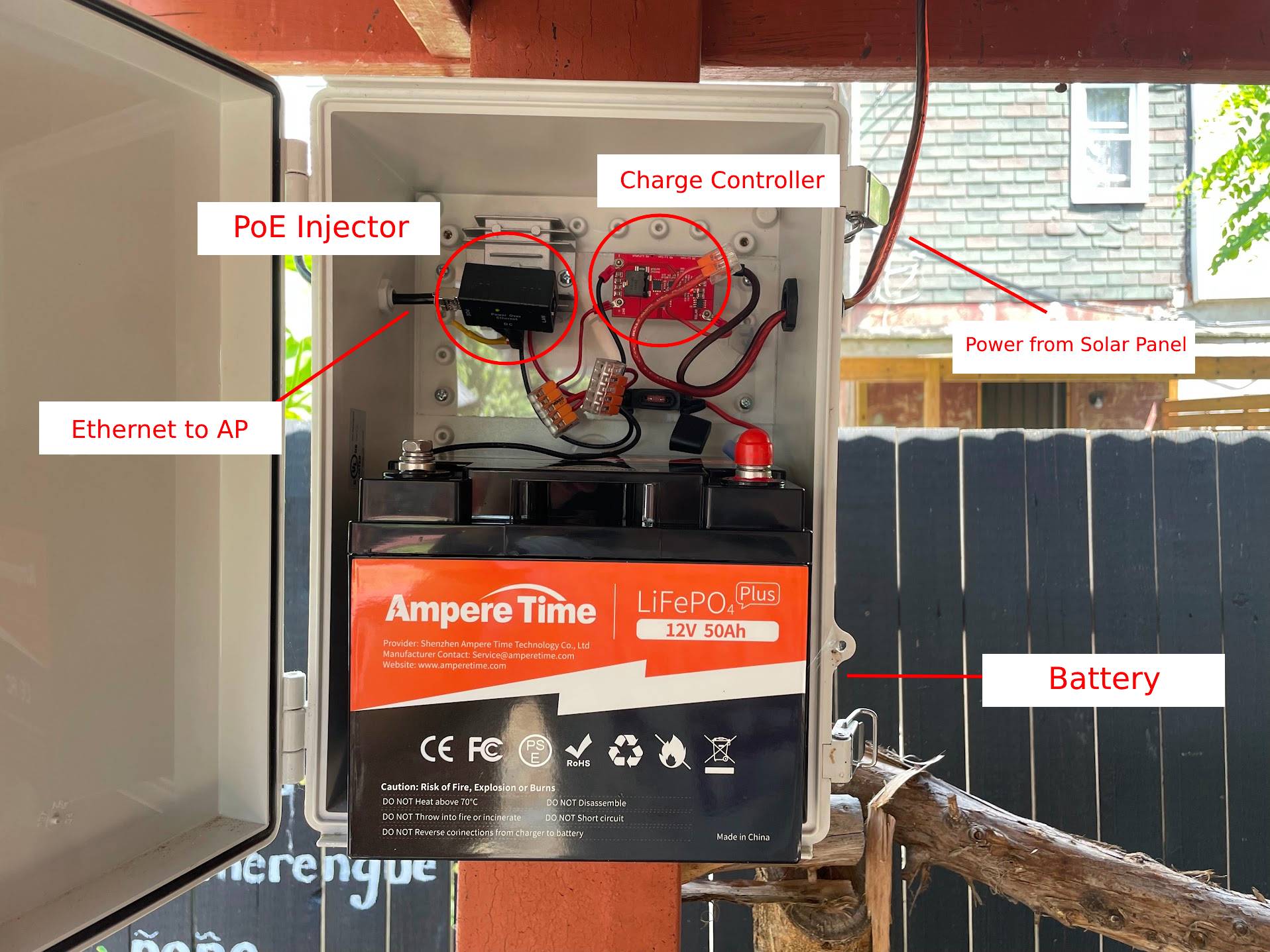
The weather-proof enclosure holds everything that is not the panel or the access point: the battery, the charge controller, and the PoE injector that carries power up to the AP over a single Ethernet run.
Troubleshooting Solar Mesh Nodes
For additional troubleshooting help, check out the 'Troubleshooting' section (pg. 12) of the Meshbox Documentation. Holobiont Lab's meshbox docs cover the design these nodes are based on in more detail.
Common issues include:
- Battery Discharge - the LiFePO4 battery should read between 12.5V to 14.6V.
- Anything less than 12.5V and the battery management system will shut off to save power.
- Connections between the enclosure and the charge controller, as well as the connections between the charge controller and AP.
- There should be a red light on the charge controller, and a green light on the PoE injector.
- Low temperature or bad weather conditions
Further resources
See Green Technology Resources for solar programs, urban agriculture organizations, and environmental monitoring initiatives in Philadelphia.